
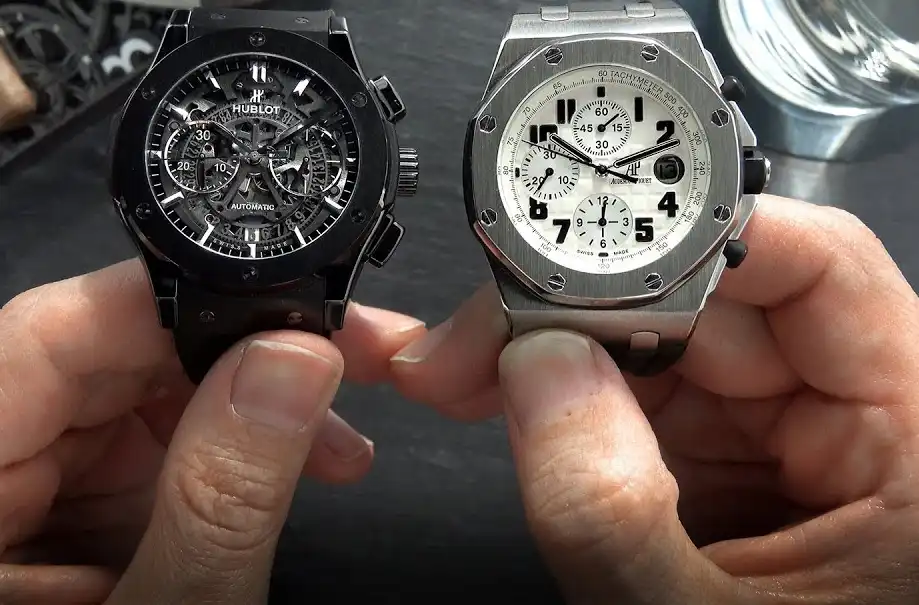
The watch world loves a fight.
Coke or Pepsi, Ferrari or Lamborghini, Rolex or Omega. But few rivalries feel quite as loud or as polarising as Audemars Piguet versus Hublot. One is steeped in centuries of craft and legacy. The other burst into the scene like a rock star crashing a black-tie gala. Both make bold statements, both sell like crazy, and both seem to irritate the other half of the collecting world.
So what really separates them? Is Audemars Piguet the untouchable craftsman while Hublot is the marketing genius? Or is there more to it than that? To find out, we have to look at what drives these two brands.
The house that built legends
Let’s start with Audemars Piguet. Founded in 1875 in the Vallée de Joux, it’s one of the last independent family-owned watchmakers in Switzerland.
That alone earns respect, but the real story is how AP changed the industry without ever shouting about it.
When the quartz crisis hit in the 1970s and every brand was panicking, Audemars Piguet did something insane.
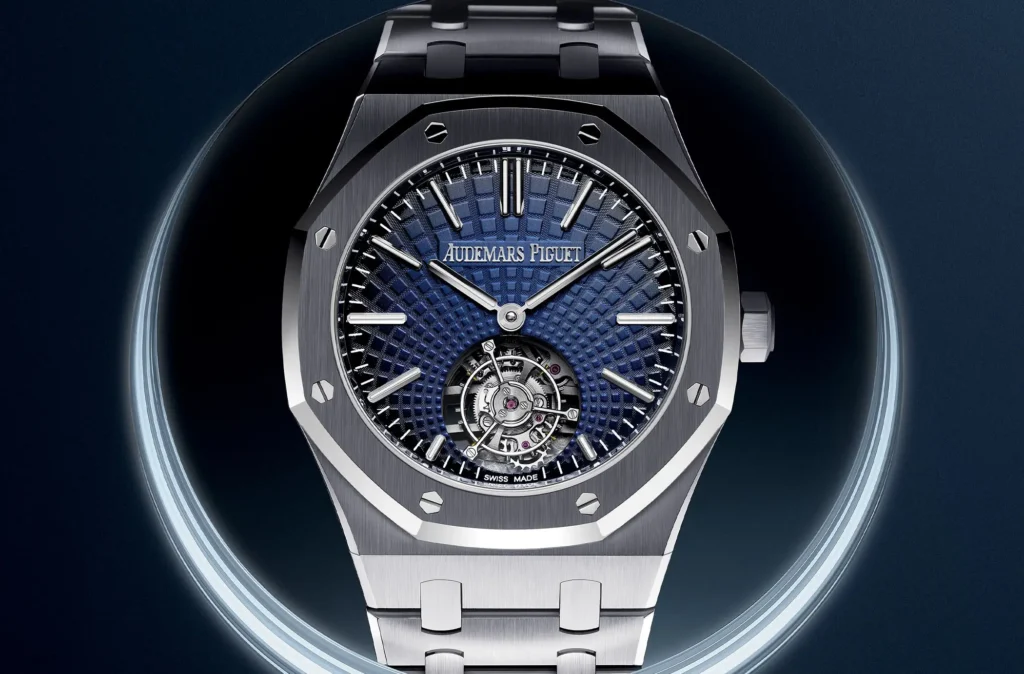
They doubled down on luxury. In 1972, they launched the Royal Oak, designed by the great Gérald Genta. It was a steel sports watch priced like gold, shaped like nothing else, with screws visible on the bezel. People thought they had lost their minds. But within a few years, the Royal Oak had redefined what luxury could be. It wasn’t about precious metals or complication counts anymore.
It was about design, engineering, and confidence.
AP’s genius has always been quiet.
The Royal Oak Offshore expanded the concept into a bolder, tougher era. The Royal Oak Concept brought avant-garde mechanics and exotic materials into haute horology.
Behind the noise of those octagonal bezels, AP continued to push genuine technical frontiers: ultra-thin perpetual calendars, double balance wheel systems, openworked movements that looked like sculpture.
When AP innovates, it’s in the details. The bevel of a bridge. The weight of a rotor. The rhythm of a tapisserie dial. They don’t need to tell you they’re masters of the craft ; the watches do the talking.
AP is that old-money gentleman who walks into the room in a perfectly tailored suit and doesn’t need to say a word.
Everyone already knows who he is.
The brand that broke the rules
Then there’s Hublot.
Founded in 1980, it’s practically a teenager compared to AP.
But my god, it knows how to make noise.
Hublot’s story really begins when Jean-Claude Biver took the wheel in 2004. Biver didn’t just sell watches; he sold an idea.
He took a brand no one was talking about and turned it into a global phenomenon using pure charisma, showmanship, and a talent for reading what modern luxury consumers wanted before they knew it themselves.
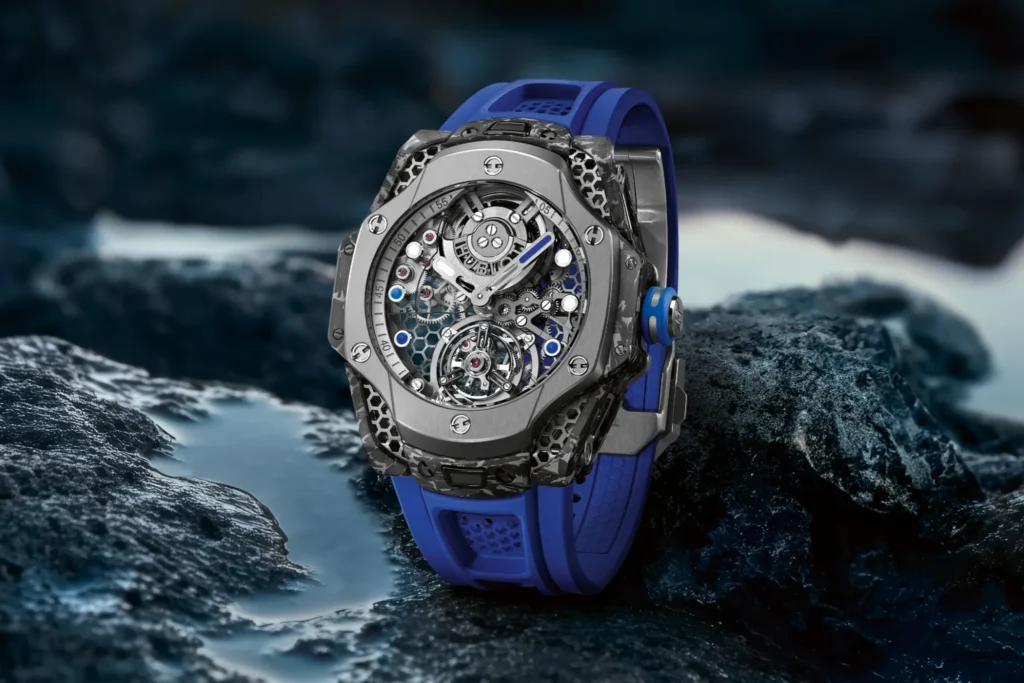
The Big Bang collection, launched in 2005, became an instant sensation. It mixed gold with rubber, carbon with ceramic, titanium with magic gold. It was unapologetic. It looked like nothing else. Collectors called it brash, critics called it derivative, but customers lined up anyway. Hublot had found the formula: fusion. Material fusion, style fusion, cultural fusion.
And then came the partnerships ; Ferrari, FIFA, Usain Bolt, art fairs, even tattoo artists. Hublot was everywhere. It wasn’t just a watch brand. It was a cultural force.
Now, was it all marketing? Yes, mostly. But to dismiss Hublot as empty hype misses the point. The brand’s material research division is one of the most advanced in Switzerland. Their in-house Unico chronograph calibre is robust and beautifully built. And unlike most heritage houses, Hublot isn’t afraid to experiment. They make watches out of sapphire, coloured ceramics, and alloys that no one else even dares to touch.
Hublot is the rock concert to AP’s symphony. Loud, modern, full of swagger. And that’s exactly why people love it.
Final thoughts
In truth, Audemars Piguet and Hublot are two sides of the same coin.
AP represents the pinnacle of traditional craftsmanship. Hublot represents the future of watchmaking as spectacle.
One builds monuments.
The other builds moments.
At Lugano Watches Dubai, we see this contrast play out every day. Collectors who buy Audemars Piguet want to feel history ticking on their wrist. They want to be part of something enduring. Collectors who buy Hublot want energy, design, personality.
They want to wear something that turns heads before they even enter the room.
So, innovation or marketing power? The truth is, both matter. Without innovation, you have style without substance. Without marketing, you have genius without an audience. AP mastered innovation first.
Hublot mastered the art of being seen.
The real trick is knowing which speaks to you. Because at the end of the day, whether it’s a Royal Oak on your wrist or a Big Bang lighting up your sleeve, you’re not just wearing a watch. You’re making a statement about what kind of collector you are.
And maybe that’s the real measure of luxury.
Not who built it first, but who made you care enough to notice.