
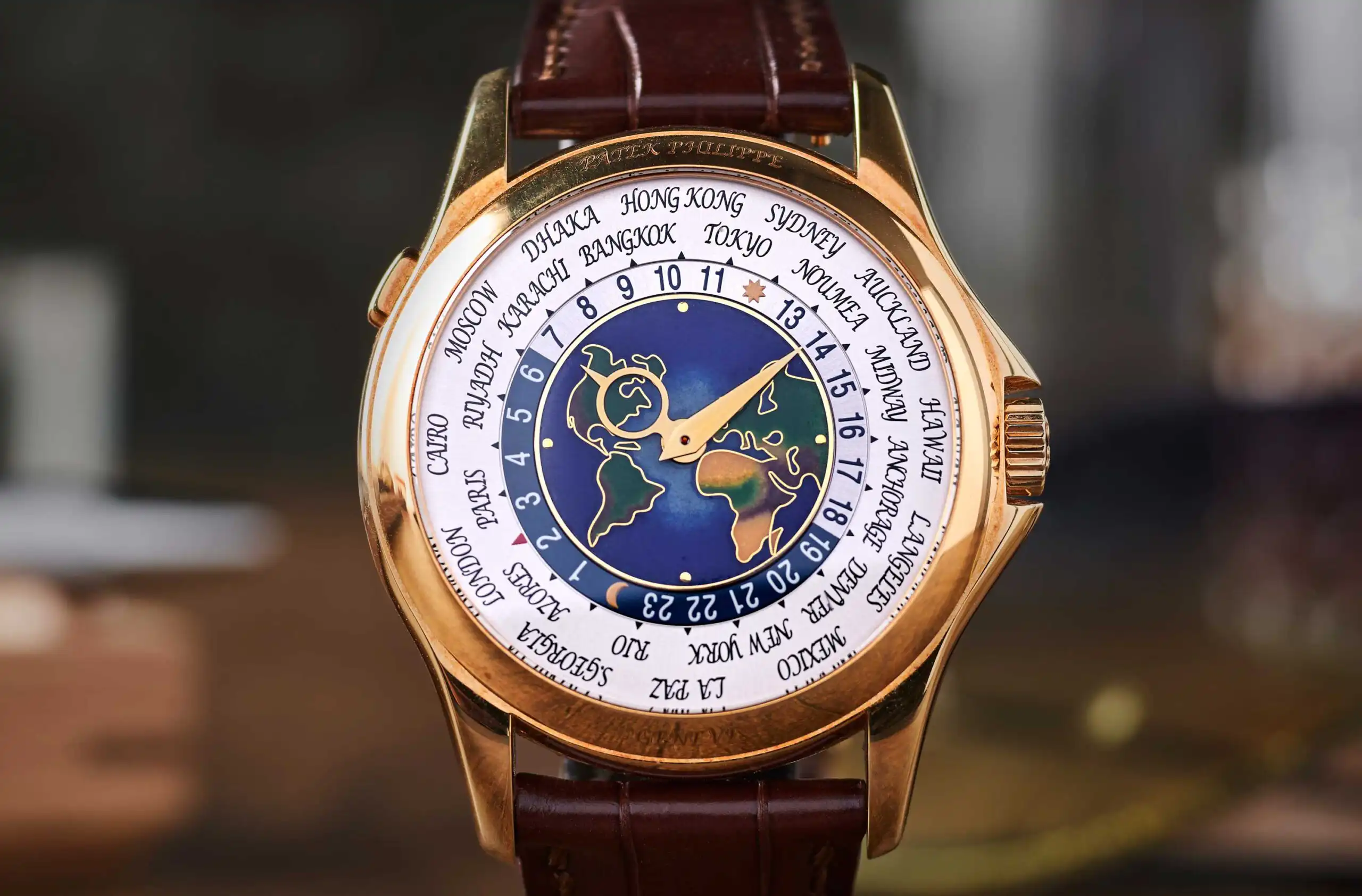
There was a time when telling the time in more than one place was a nightmare. Imagine being a 1930s banker with clients in New York, London, and Geneva, and having to keep three clocks on your desk just to stay sane.
Then came one of the greatest inventions in horology: the world time watch.
A single dial that showed you the hour in every major city at once. It was pure theatre.
This wasn’t born from convenience alone. It was born from ambition. Humanity had suddenly gone global. Trains, ships, and planes had shrunk the world, and watchmakers were desperate to match that sense of motion.
If you couldn’t travel the world, you could at least wear it on your wrist.
Today, world time watches are the wrist equivalent of a private jet. Elegant, confident, and quietly smug. But how they got here, from mechanical maps to micro-engineered marvels, is one of the most fascinating stories in all of watchmaking.
The genius of Louis Cottier and the golden age of travel
Like all great inventions, the world time watch started with one man who refused to accept that things were complicated.
In the 1930s, a Swiss watchmaker named Louis Cottier developed a system that allowed a single movement to display all 24 time zones simultaneously.
His idea was brilliantly simple.
The cities of the world would be printed around the dial, and a rotating 24-hour disc beneath them would show the corresponding times.
Cottier’s invention was first used by Patek Philippe, and it changed everything.
The Patek Philippe Ref. 1415 became an icon of sophistication, the ultimate gentleman’s travel companion. There were no buttons, no menus, no screens.
Just pure mechanical poetry that let you know what time it was in Rio, Moscow, or Tokyo at a glance.
These early pieces captured a romance that’s easy to miss today.
They were made in an age when travel itself was exotic.
The jet age was dawning, and to own a world time watch was to belong to that rare club of people who actually needed one. Diplomats, industrialists, explorers. The kind of people whose luggage had initials stamped in gold and whose itineraries were handwritten by assistants.
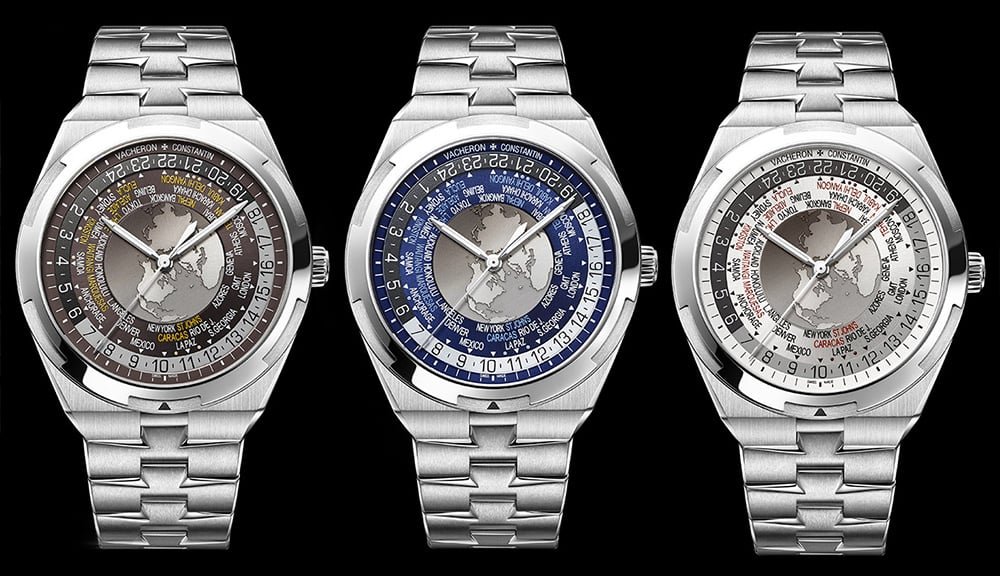
When Cottier’s system spread to other brands, it became a hallmark of intellectual luxury. Vacheron Constantin, Audemars Piguet, and Longines all adopted it, each adding their own flourish. These watches weren’t just tools; they were declarations of curiosity.
They said, “I know the world is bigger than me, but I have it under control.”
And it wasn’t just mechanics.
The artistry of these dials became legendary. Cloisonné enamel maps of the world, hand-painted continents, shimmering oceans , each dial was a miniature masterpiece. When you looked down at your wrist, you weren’t just checking the time. You were admiring civilization condensed into 38 millimetres of gold and glass.
The modern transformation and what it says about us
Fast-forward to today, and the world time complication has evolved alongside us. We live in a world of constant connectivity, but oddly enough, that’s made the world time watch more relevant, not less. Because in a world of digital sameness, mechanical craftsmanship feels alive.
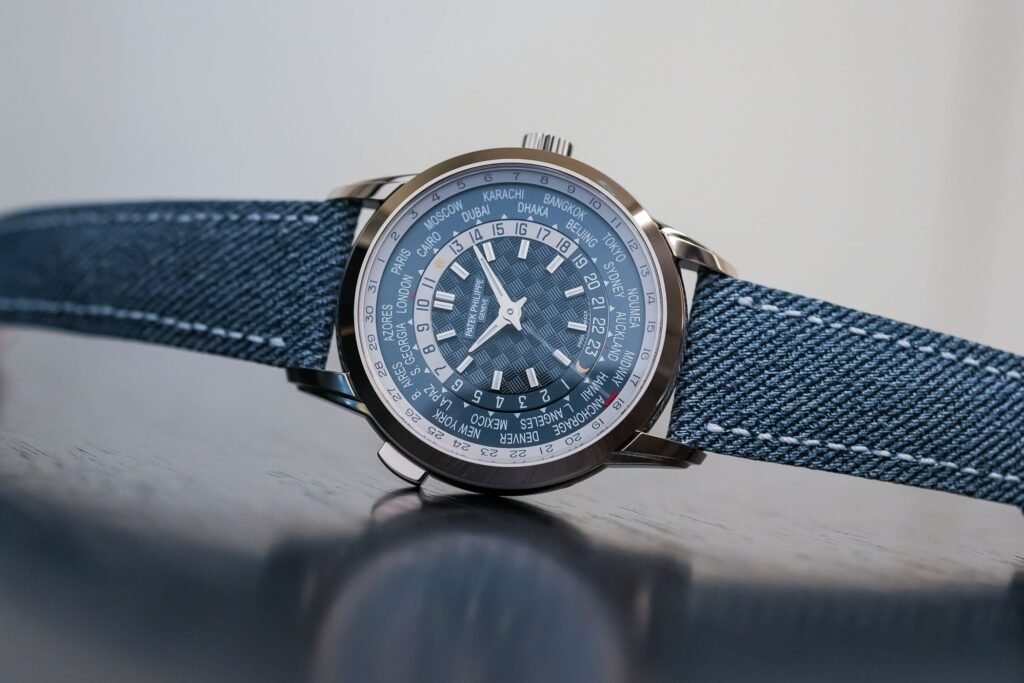
Modern icons like the Patek Philippe World Time Ref. 5231J, Jaeger-LeCoultre Geophysic Universal Time, and Vacheron Constantin Traditionnelle World Time have reimagined the complication with new materials and staggering precision.
Where Cottier’s originals used a manual disc, these modern versions use layered mechanisms that keep the cities and hours aligned no matter how you adjust the local time.
It’s horological ballet performed in brass, steel, and sapphire.
Then there are the outliers, the innovators who refuse to play it safe. Greubel Forsey and Girard-Perregaux turned the world time into a three-dimensional experience, with globes and rotating hemispheres instead of printed discs.
You don’t just read the time.
You see the Earth turning.
It’s mechanical philosophy at its finest , the idea that you can hold the world in your palm.
At Lugano Watches Dubai, collectors have a particular fondness for these pieces. Dubai is a crossroads city. You can stand in our showroom and overhear conversations in half a dozen languages before you’ve even finished your coffee. That’s why world time watches resonate here. They’re not just complications; they’re reflections of identity. A watch that reminds you where you came from, where you’re going, and how far you’ve already travelled.
And that’s the beauty of the modern world timer. It isn’t just a technical achievement. It’s a philosophy rendered in metal.
It says that while time divides us, craftsmanship connects us.
Final thoughts
World time watches began as tools for travellers.
Today, they’re monuments to curiosity. They’ve gone from instruments of necessity to symbols of perspective.
In an era where your phone tells you everything instantly, a mechanical world timer reminds you that understanding the world takes patience , and maybe a few gears.
Every rotation of that 24-hour disc is a reminder that someone, somewhere, is waking up while you go to sleep. It’s a celebration of difference, of rhythm, of the poetry in precision.
And perhaps that’s why collectors still love them.
Because when you wear a world time watch, you aren’t just measuring hours.
You’re participating in the quiet symphony of human existence.
You feel connected to something larger, something turning steadily beyond your control, yet perfectly within your grasp.
In a world obsessed with what’s next, the world time watch still invites us to look around. Not just at time, but at the whole planet ticking together.