
A deep dive into the rise of salmon dial watches, why they stir such desire among collectors, and what makes this shade one of horology’s most intriguing stories.
There are trends in watchmaking that come and go so quickly you barely have time to notice them.
Then there are the rare few that seem to sink their hooks deep into the collective psyche of the watch world, where they stay for years, whispered about in collector circles and fought over at auctions. The salmon dial belongs firmly in that second category.
The fascination borders on cultish.
It is not just a colour.
It is a mood, a statement, and in some cases, a status symbol that speaks more loudly than the logo on the dial.
If you have ever handled a truly great salmon dial in the metal, you will understand why photographs almost never do them justice. The colour shifts in subtle, almost imperceptible ways depending on light, surroundings, and the metal of the case. One moment it leans warm and coppery, the next it feels cool and silvery. That ambiguity is part of its charm. Unlike a simple black or white dial, salmon does not merely sit there.
It interacts with its environment and with you.
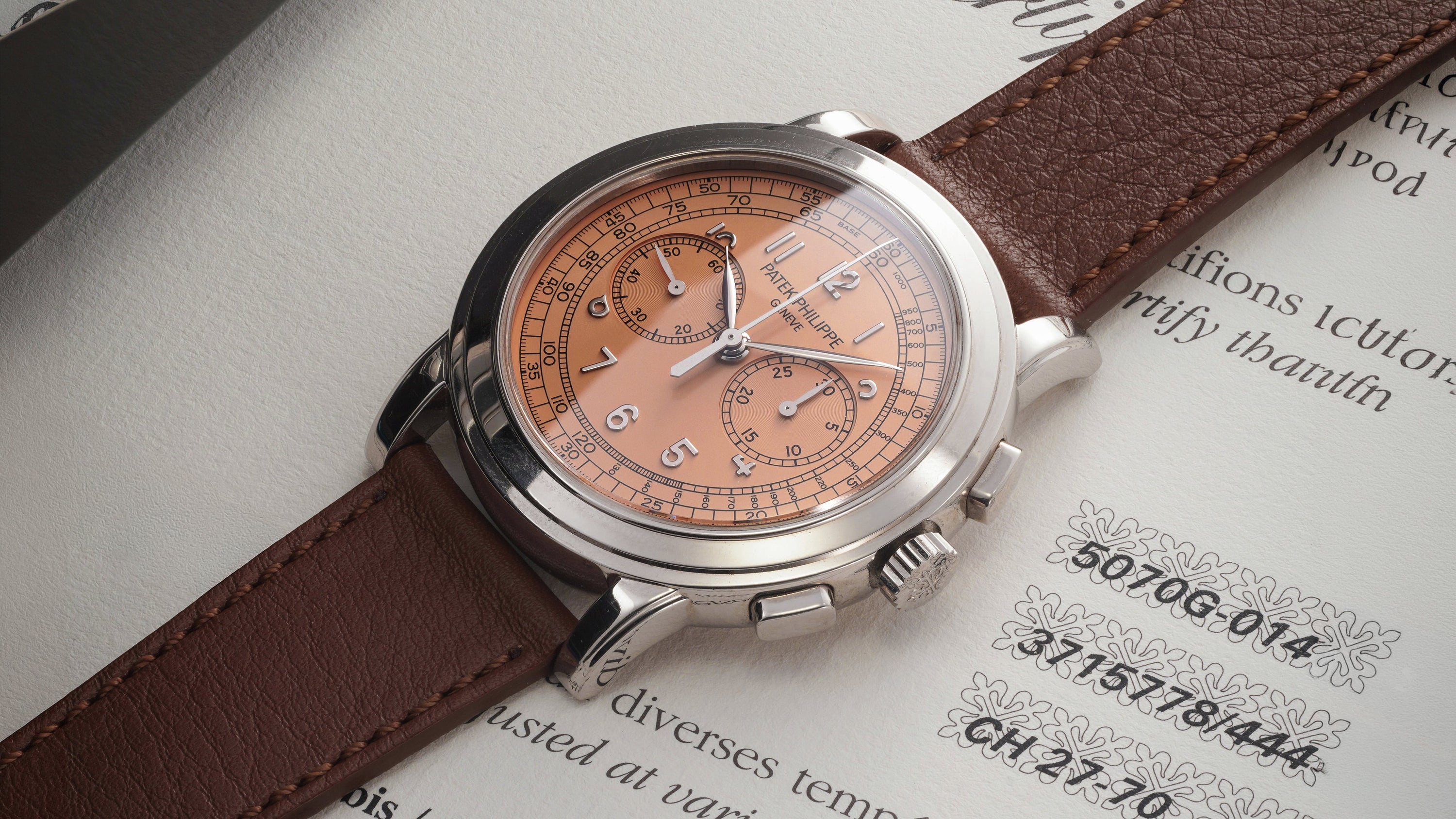
The idea of a salmon dial might sound modern, but its origins are far from recent. The first examples appeared in the early to mid-20th century, often on special-order watches from the likes of Patek Philippe, Vacheron Constantin, and Audemars Piguet.
In those days, a salmon dial was not part of the standard catalogue.
It was something you requested if you knew it existed at all, and that alone made it rare. Many of the early examples were paired with precious metal cases, particularly pink gold or steel, creating a harmony of tones that collectors today still find irresistible.
For decades, the salmon dial remained an insider’s choice.
You would see one in the auction catalogue of Antiquorum or Phillips and marvel at its odd beauty. The dial was often matched with Breguet numerals or applied gold markers, and sometimes paired with intricate complications like perpetual calendars or split-second chronographs.
The rarity was compounded by the fact that many of these dials were made using galvanic or chemical treatments that are difficult to reproduce today.
In some cases, the colour was the result of natural ageing, oxidation lending the surface a pinkish hue that became even more sought after precisely because it could not be faked.
It was only in the past two decades that salmon dials began to break into the mainstream consciousness. Limited editions from F.P. Journe, A. Lange & Söhne, and Laurent Ferrier made the colour newly relevant, while brands like Tudor and Longines brought it to a wider audience without diluting its mystique.
The appeal suddenly crossed the boundaries between haute horology and more accessible luxury, but it never lost its aura.

The obsession is not just about aesthetics, though that plays a big part.
The truth is, a salmon dial carries a different kind of cultural weight in watchmaking. It suggests you know something most people do not. It is not the most obvious choice in a display case full of black, blue, and silver dials.
You have to seek it out.
And that is precisely why seasoned collectors gravitate toward it. It signals that you are not chasing trends, you are choosing pieces that speak to you on a deeper level.
There is also the matter of versatility. While salmon may seem like an unusual choice for a dial colour, it pairs effortlessly with a surprising range of outfits and metals. In white gold or platinum cases, it feels cool and restrained, almost minimalist in tone. In pink or rose gold, the warmth of the case amplifies the richness of the dial, creating a luxurious harmony.
Even in steel, the colour holds its own, lending a touch of unexpected sophistication to what might otherwise be considered a utilitarian case material.
For many collectors, owning a salmon dial watch is also about joining a lineage. When you strap one on, you are connected to the great pieces of the past — the 1940s Patek perpetual calendars, the Vacheron triple calendars, the vintage Audemars Piguet chronographs that rarely leave private collections. It is an unspoken link between you and the watchmakers, artisans, and owners who came before. And because production of salmon dials is still limited across most brands, they retain their rarity even in modern collections.
From a psychological perspective, part of the magic lies in how salmon dials challenge the idea of what a “serious” watch should look like.
They prove that colour can be elegant, restrained, and timeless without being loud.
The hue manages to be playful and formal at the same time, a balancing act few other dial colours achieve so naturally.
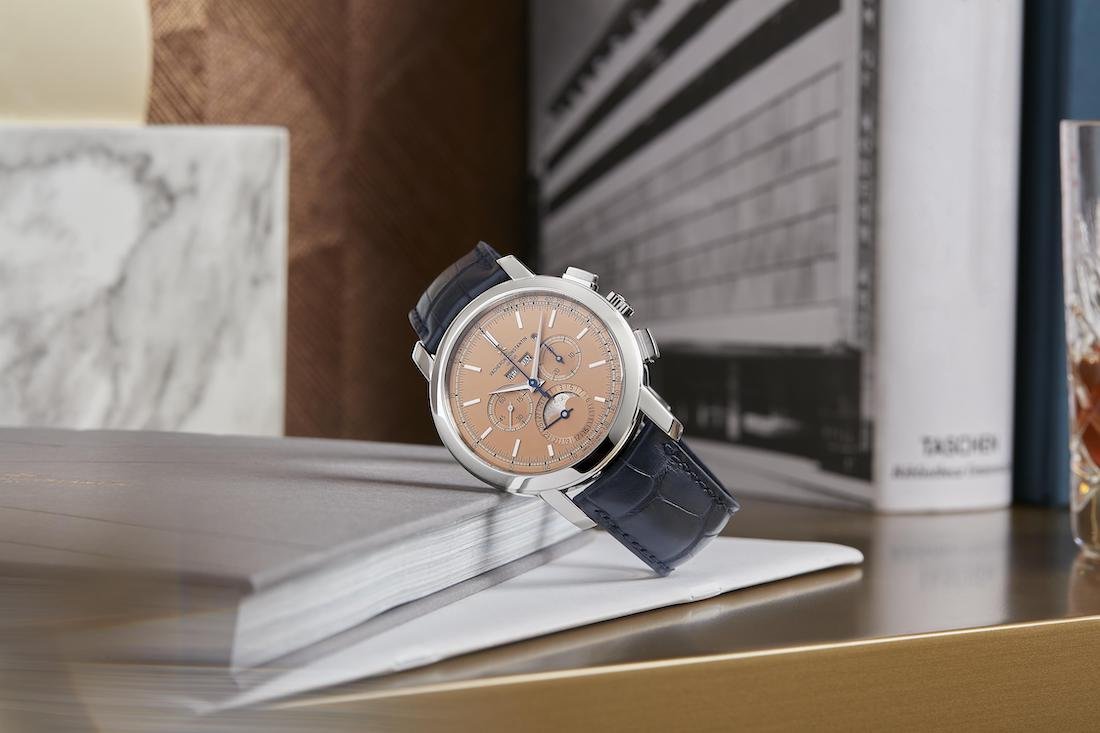
We are living through a kind of salmon dial renaissance. More brands are experimenting with the shade, but crucially, they are doing it in ways that preserve its exclusivity. You will not find mass-produced salmon dials flooding the market in the same way blue dials did over the past decade.
The better brands understand that part of the appeal is scarcity. That means most salmon releases are tied to limited runs, boutique exclusives, or anniversary editions.
High horology continues to lead the way.
Independent makers are finding ways to reinvent the salmon dial with textures, sunburst patterns, or hand-guilloché surfaces that catch light in unpredictable ways. Some are experimenting with metals like gold or silver as the base for the dial, allowing the salmon tone to develop from beneath the surface rather than as a painted layer. This gives the colour more depth and a unique way of ageing over time.
At the same time, a handful of mainstream brands are offering salmon dials in their collections, though usually in restrained quantities.
This has a dual effect.
It introduces more people to the aesthetic, while still leaving plenty of room for the truly exceptional pieces to stand apart. The key for collectors now is discernment. Not all salmon dials are created equal. The subtle variations in tone, texture, and execution make all the difference between a watch that feels like a future classic and one that simply follows a colour trend.
There is also a growing appreciation for how salmon dials photograph.
On social media, they perform incredibly well because of their chameleon-like quality. In one image, the dial might appear soft and pastel; in another, rich and metallic.
This variability keeps people looking. It makes you want to see the watch in person, which is when the real seduction happens.

A salmon dial watch is not just another shade in the spectrum of horology. It is an object lesson in how colour can carry history, personality, and rarity in equal measure. To own one is to participate in a tradition that values nuance over novelty. It is not about being loud or obvious. It is about wearing something that whispers rather than shouts, but that those in the know will hear immediately.
The obsession will not fade anytime soon because the salmon dial offers something most watch trends cannot: genuine timelessness. It is a colour that feels both rooted in the golden age of watchmaking and perfectly suited to modern tastes. And when you finally have one on your wrist, you will understand why collectors speak about them with a mixture of reverence and desire.
It is not just a watch you are wearing.
It is a conversation, a lineage, and in its own quiet way, a crown.